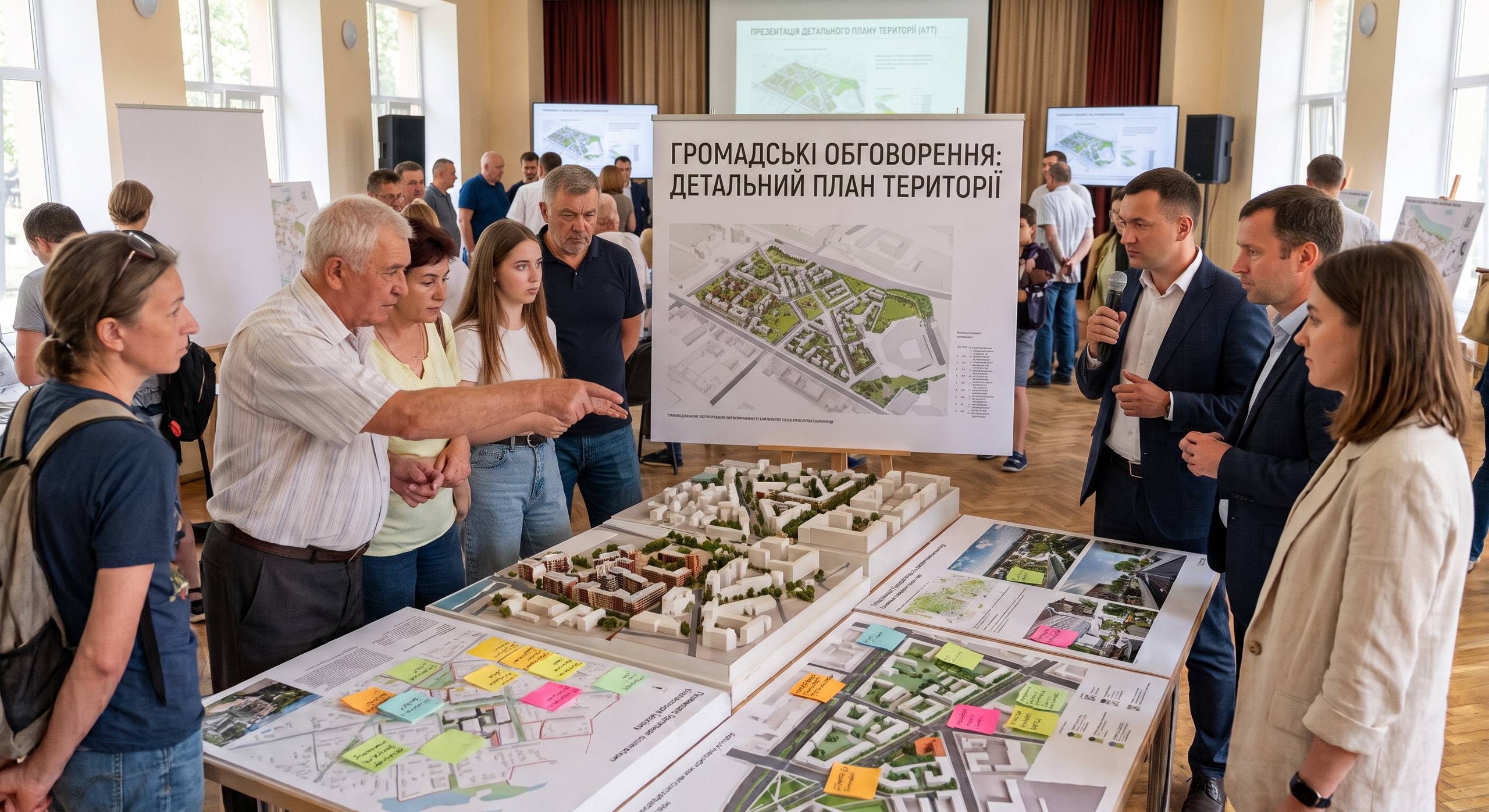
Public discussions and hearings as a tool for information support and consideration of public interests in spatial planning
The master plan of a settlement, the comprehensive spatial development plan of a territorial community, or the detailed plan of a territory are documents that determine what a specific street, district, or entire city will look like for decades to come. Therefore, the legislator did not leave the developers of such documentation the right to […]

The master plan of a settlement, the comprehensive spatial development plan of a territorial community, or the detailed plan of a territory are documents that determine what a specific street, district, or entire city will look like for decades to come. Therefore, the legislator did not leave the developers of such documentation the right to approve it without the reaction of the people who live in this territory. Public discussion is a mandatory stage in the preparation of such documentation, and the approval of a draft without it is expressly prohibited by law.
What the procedure is based on
The basis is the Law of Ukraine “On Regulation of Urban Development Activity” No. 3038-VI of 17.02.2011, namely Article 21 and Article 21-1. The details of the procedure itself — who chairs the hearings, how the minutes are kept, how the progress of the event is recorded — are spelled out in the Resolution of the Cabinet of Ministers of Ukraine of 25.05.2011 No. 555 “On Approval of the Procedure for Conducting Public Hearings on Consideration of Public Interests during the Development of Draft Urban Planning Documentation at the Local Level”.
Both documents are regularly updated, so the current wording should be checked directly on the portal of the Verkhovna Rada — zakon.rada.gov.ua. It is there that the text has legal force, and not in the retellings or comments of third-party sources.
Discussion and hearing are not the same thing
In practice, these two terms are often confused. Public discussion is a general procedure: the draft documentation is made public, and within the established period, the public can submit written proposals or comments. Public hearings are a specific form of such a discussion, a face-to-face event where the project is presented publicly and people can express themselves directly, not just on paper.
Here it is worth clarifying who exactly falls under the concept of “public”. Procedure No. 555 defines it as one or more individuals or legal entities, their associations, organizations or groups registered in the territory covered by the draft documentation. That is, the right to submit proposals is linked to registration, residence or activity in this specific territory, and not to arbitrary belonging to the general public.
All drafts of urban planning documentation at the local level are subject to discussion — master plans, comprehensive plans for the spatial development of the territorial community, detailed plans of the territory. The law expressly prohibits the approval of such documentation without discussion. The only exception concerns the compulsory alienation of land plots or property for public needs — in this case, hearings are not held, since a separate specialized law applies.
What the documentation customer is obliged to do
The responsibility for organizing the discussion lies with the customer of the documentation — usually a local self-government body. It must make public the decision itself on the development of documentation, along with the predicted legal, economic consequences and consequences for the environment and public health. Further, the project itself, an explanatory note, and a report on the strategic environmental assessment must appear on the official website — and access to these materials must be free, without registrations and other obstacles.
After that, the customer registers, considers, and takes into account the proposals of the public, conducts the hearings themselves, and if necessary, creates a conciliation commission for controversial issues. The final step is the publication of the results of the consideration of proposals so that people can see exactly what was taken into account and what was rejected and why.
How much time residents have
For those who plan to submit comments, this is one of the key practical points. The deadline for submitting proposals to the public cannot be less than 30 days from the date of publication of the draft documentation — everything submitted later is no longer accepted for consideration. The hearings themselves can take place no earlier than 10 days after the publication of the project.
Conciliation commission: when opinions differ
If controversial issues arise during the discussion process, a conciliation commission may be formed to resolve them. Its composition includes officials of the customer, representatives of land resources, environmental protection, health care, urban planning and architecture, cultural heritage protection bodies, as well as specialists and scientists. Separately, it includes authorized representatives of the public, elected directly during the hearings, and the law protects their role quite specifically — such a group should constitute at least 50% and no more than 70% of the total composition of the commission.
The commission considers controversial issues within two weeks after its formation. A meeting is considered valid if at least two-thirds of the members are present, of which at least half are representatives of the public. If it is impossible to reach an agreement, the final decision still remains with the documentation customer.
What happens to the results
The customer must publish the results of the consideration of proposals within two weeks from the date of their adoption — through local media and on its own official website. Those who publish them are responsible for the authenticity of the posted materials, and this is an additional incentive not to distort and not to hide inconvenient proposals. All costs for organizing the discussion are borne by the customer, so participation in the procedure costs the residents themselves nothing.
What function this procedure actually performs
Residents learn about the planned changes to the territory before making a decision, when there is still an opportunity to influence its content, and not post factum. The obligation to consider and respond in writing to each proposal forces the developers of the documentation to argue their decisions publicly. As a result, the documentation is formed taking into account the real needs of citizens and the characteristics of the territory, and not just technical calculations — and this is exactly why spatial planning exists.
